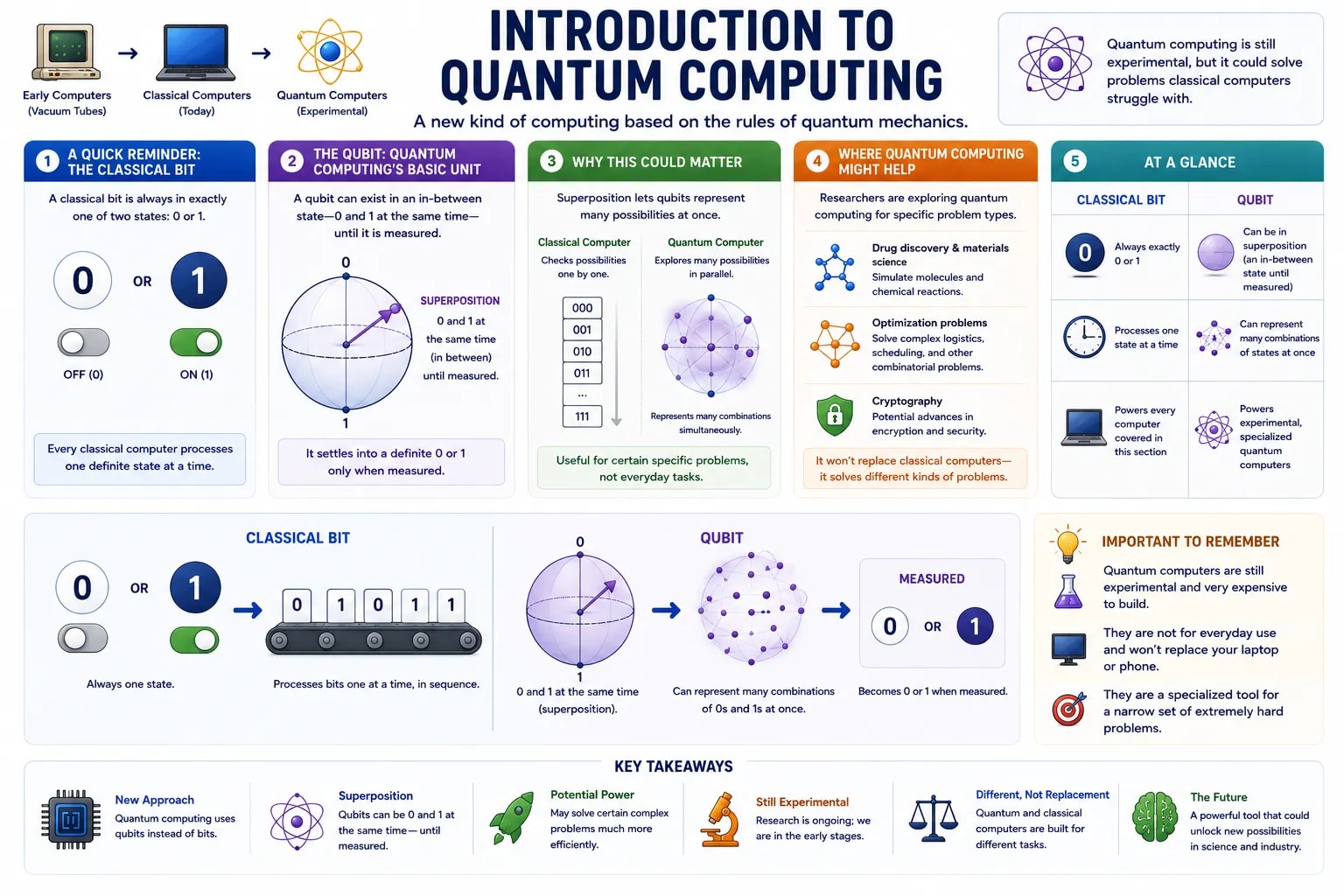
Every computer covered so far in this section — from the first vacuum-tube machines to the laptop or phone you're reading this on — is a classical computer, built on the binary bits covered in the number systems lesson. Quantum computing is a very different, much newer approach that is still mostly experimental. This lesson keeps things at a beginner-safe level: the core idea, not the physics.
As covered earlier in this section, a classical bit is always in exactly one of two states: 0 or 1, on or off. Every classical computer, no matter how powerful, processes information one definite state at a time, even when it does so billions of times per second.
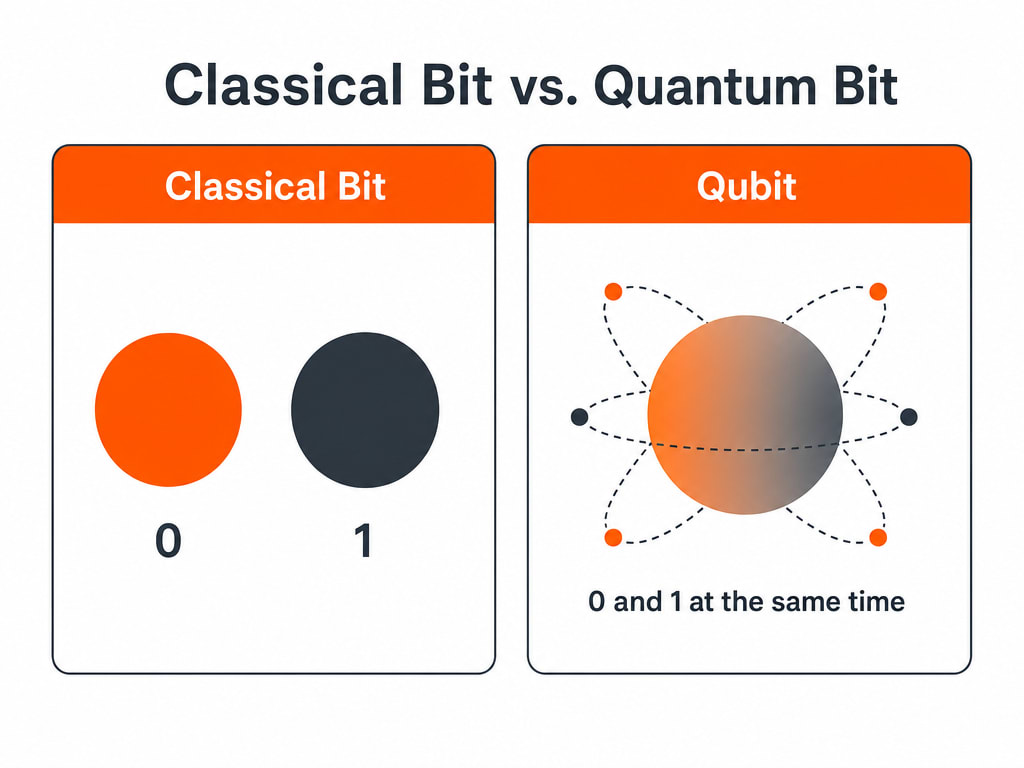
A quantum computer's basic unit is called a qubit (quantum bit). Instead of being locked into 0 or 1 the way a classical bit is, a qubit can exist in a special in-between state — commonly described as being 0 and 1 "at the same time" — until it is measured, at which point it settles into a definite 0 or 1. This property is called superposition, and it is the single most important idea to take from this lesson: it is also a simplification of genuinely strange physics that even professional physicists describe carefully, so treat "at the same time" as a beginner-friendly approximation, not a literal, complete description.
Because a group of qubits in superposition can represent many possible combinations of 0s and 1s simultaneously, a quantum computer may be able to explore a huge number of possibilities in parallel for certain specific problems — rather than checking them one at a time, the way a classical computer must. This does not make quantum computers faster at everyday tasks like browsing the web or editing a document; the advantage, where it exists, is narrow and specific.
Researchers are exploring quantum computing for a handful of specific problem types: simulating molecules and chemical reactions for drug and materials research, optimization problems with enormous numbers of possible combinations (like complex logistics or scheduling), and certain areas of cryptography. It is not expected to replace the classical computer on your desk — the two are built for different kinds of problems entirely.
| Classical bit | Qubit |
|---|---|
| Always exactly 0 or 1 | Can exist in superposition — an in-between state until measured |
| Processes one state at a time | Can represent many combinations of states at once |
| Powers every computer covered in this section | Powers experimental, specialized quantum computers |
This Is Not Coming to Your Desk Anytime Soon
Quantum computers are still experimental, expensive, and difficult to build reliably — they are not sold as everyday consumer devices, and this is unlikely to change soon. Nothing about the classical computers covered in the rest of this section is going away; quantum computing is a specialized tool for a narrow set of very hard problems, not a general replacement.
The final lesson in this section looks at a very different but equally future-facing topic: artificial intelligence, and why it has become such a major part of how people think about computing today.