Back in the generations-of-computers lesson, artificial intelligence was named as the technology defining the fifth generation of computing. This final lesson in the Computer Basics section looks at what that actually means — what AI is, where you already encounter it, and its honest limits.
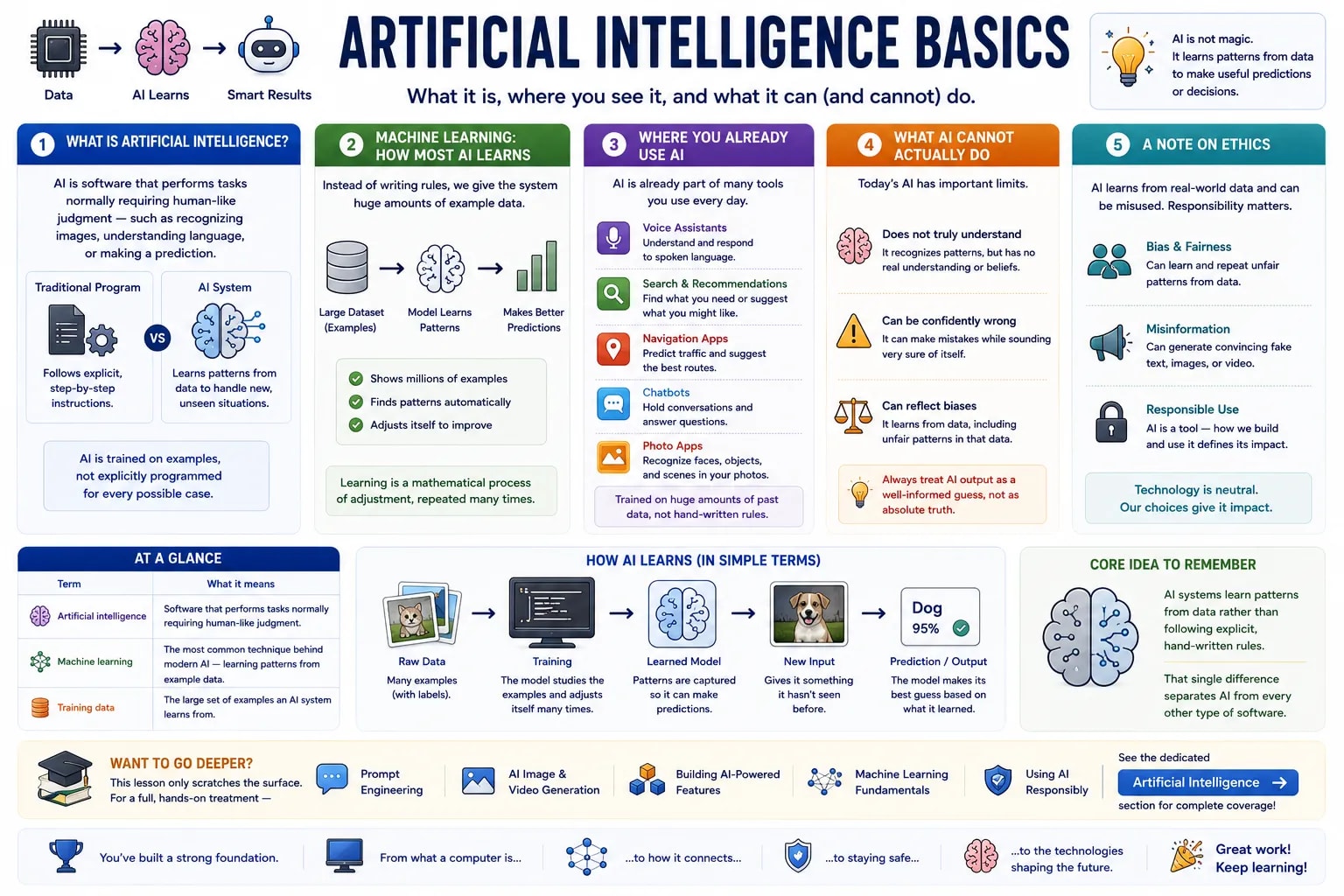
Artificial intelligence (AI) is software built to perform tasks that normally require human-like judgment — recognizing an image, understanding language, or making a prediction — rather than simply following a fixed, step-by-step set of instructions for every possible situation. A traditional program is explicitly told exactly what to do for each case; AI systems are instead trained on large amounts of example data, and they learn patterns from those examples that let them handle new, unseen situations reasonably well.
The most common approach behind today's AI is called machine learning: instead of a programmer writing exact rules, the software is shown enormous amounts of example data — millions of labeled photos to learn what a cat looks like, for instance — and it gradually adjusts itself to get better at the task. The "learning" is really a mathematical process of adjustment, repeated an enormous number of times, not learning in the human sense of understanding.
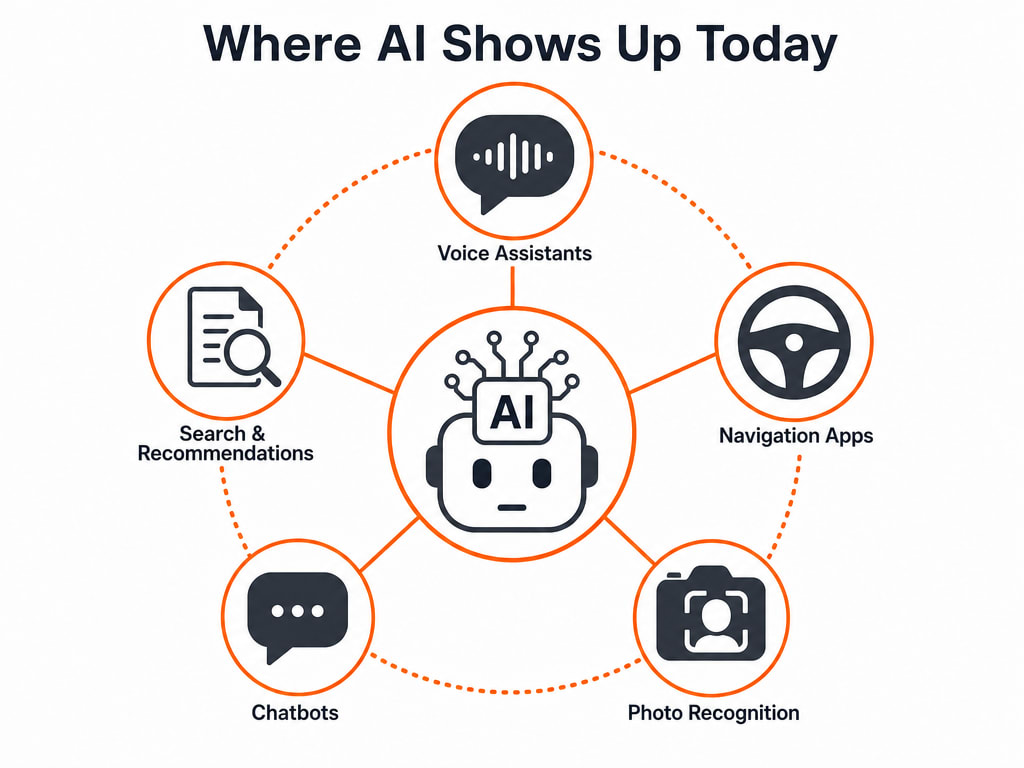
AI is already woven into tools you likely use daily. Voice assistants use AI to understand spoken language. Search engines and recommendation systems use it to guess what you're looking for or might want to watch next. Navigation apps use it to predict traffic and suggest routes. Chatbots use it to hold a conversation. Photo apps use it to recognize faces and objects in your pictures. In each case, the same core idea applies: the software was trained on huge amounts of past examples rather than explicitly programmed with a rule for every situation.
Despite how convincingly it can sometimes perform, today's AI does not genuinely understand meaning, have beliefs, or think the way a person does — it recognizes and reproduces patterns from its training data, extremely well in many cases, but without comprehension behind it. It can also be confidently wrong, and it can reflect biases present in the data it was trained on. Treating AI output as always correct, rather than as a well-informed guess, is one of the most common mistakes people make with it today.
Because AI systems learn from real-world data, they can pick up and repeat unfair patterns already present in that data. Because they can generate convincing text, images, and video, they can also be misused to spread misinformation or impersonate real people. None of this makes AI inherently good or bad — like every technology covered in this section, it is a tool, and the responsibility for using it well sits with the people building and using it.
| Term | What it means |
|---|---|
| Artificial intelligence | Software that performs tasks normally requiring human-like judgment |
| Machine learning | The most common technique behind modern AI — learning patterns from example data |
| Training data | The large set of examples an AI system learns from |
The Core Idea Outlasts Any Specific Tool
This is a fast-moving field, and specific tools and capabilities change quickly — but the core idea in this lesson does not: AI systems learn patterns from data rather than following explicit, hand-written rules, and that single distinction is what separates them from every other type of software covered in this section.
Want to Go Deeper?
This lesson only scratches the surface. For a full, hands-on treatment — prompt engineering, AI image and video generation, building AI-powered features, machine learning fundamentals, and using AI responsibly — see the dedicated Artificial Intelligence section.
This closes out the Computer Basics section. You have gone from "what is a computer" all the way to the technologies shaping where computing is headed next — a foundation the rest of this site's lessons build on directly.