Every lesson in this section has built toward one idea: computers are general-purpose machines that do whatever their software tells them to. This lesson looks at what that actually means in practice — the real, everyday fields where computing quietly does the work.
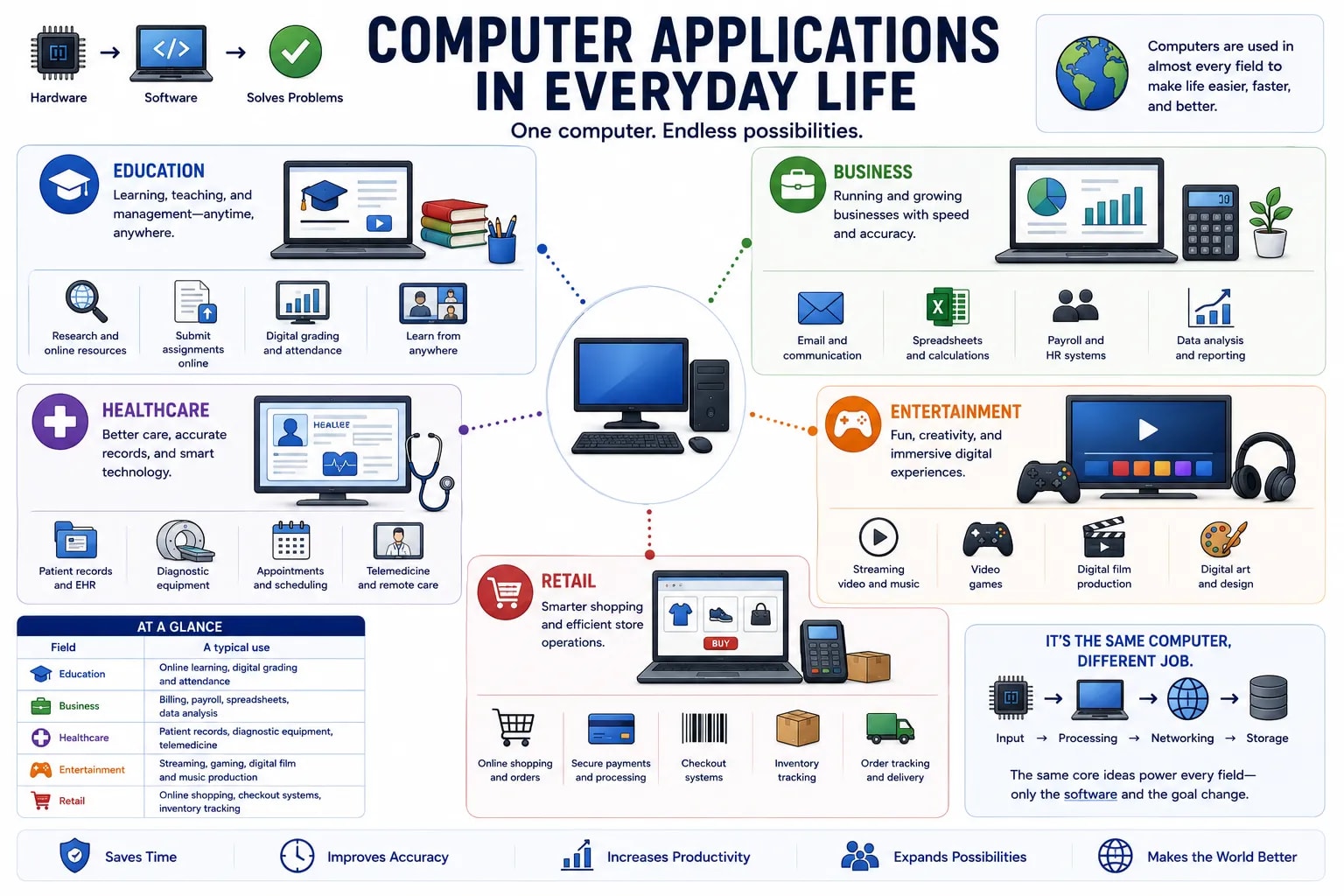
Computers now shape nearly every stage of learning: students research topics and submit assignments online, teachers track grades and attendance digitally, and interactive lessons — like the ones in this very course — let people learn at their own pace from anywhere with an internet connection. Distance learning, impossible without computers and networking, has made education reachable for people who could never attend a physical classroom.
From a small shop's billing software to a multinational company's inventory and payroll systems, computers run the everyday machinery of business. Email and video calls replaced much of the need for in-person meetings, spreadsheets handle calculations that used to take hours by hand, and data analysis helps companies make decisions based on evidence instead of guesswork.
Hospitals use computers to store patient records securely and make them instantly available to authorized staff, to run diagnostic equipment like MRI and CT scanners, and to schedule appointments and manage medicine inventories. Telemedicine — seeing a doctor over a video call — depends entirely on the networking concepts covered earlier in this section.
Streaming video and music, video games, and digital art and film production all run on computing power. Even entertainment that feels completely offline, like a live concert, usually relies on computers behind the scenes for lighting, sound mixing, and ticketing.
Online shopping, in-store checkout systems, and inventory tracking all depend on computers to work at the scale modern retail operates at. A single online order quietly involves a website, a payment processor, and an inventory database all communicating with each other in the seconds it takes to click "buy."
| Field | A typical use |
|---|---|
| Education | Online learning, digital grading and attendance |
| Business | Billing, payroll, spreadsheets, data analysis |
| Healthcare | Patient records, diagnostic equipment, telemedicine |
| Entertainment | Streaming, gaming, digital film and music production |
| Retail | Online shopping, checkout systems, inventory tracking |
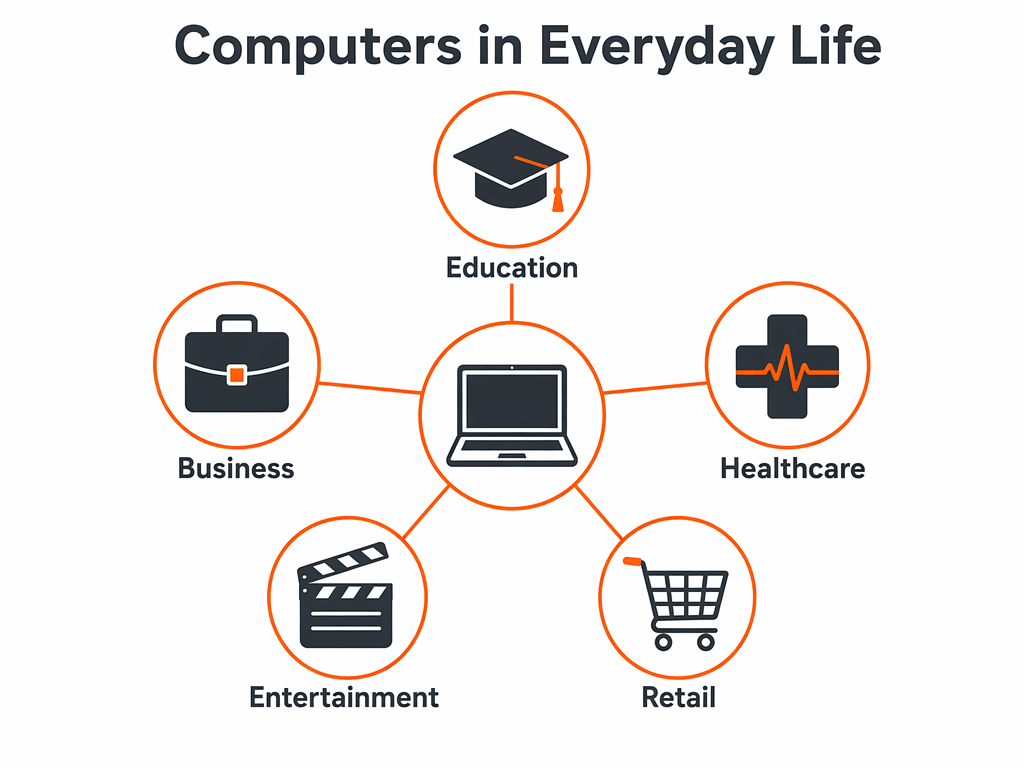
It’s the Same Computer, Doing a Different Job
Notice that no new kind of "special" computer appears in any of these fields — the same hardware and software concepts from earlier in this section (input, processing, storage, networking) are simply pointed at a different job each time. This is the general-purpose idea from the very first lesson, playing out at the scale of an entire economy.
You have now seen where computing already is. The final two lessons in this section look ahead — to quantum computing and artificial intelligence, two of the biggest forces shaping where computing goes next.