

Every AI use covered so far responds to what you say. An agent goes further — it can take actions, not just generate text, which is the difference this lesson is really about.
A basic chatbot waits for your input and replies. An agent can additionally:
Most agents follow a loop called ReAct — short for Reasoning and Acting — repeatedly thinking, acting, and observing the result until it has enough to answer:
User: "What is the current weather here, and should I carry an umbrella tomorrow?"

Agent THOUGHT: "I need current weather data. I'll use the weather tool."
Agent ACTION: search_weather("current location")
Agent OBSERVATION: "Tomorrow: 80% chance of rain, warm and humid."
Agent THOUGHT: "I now have what I need to answer."
Agent FINAL ANSWER: "There's an 80% chance of rain tomorrow — yes,
carry an umbrella. It'll be warm and humid."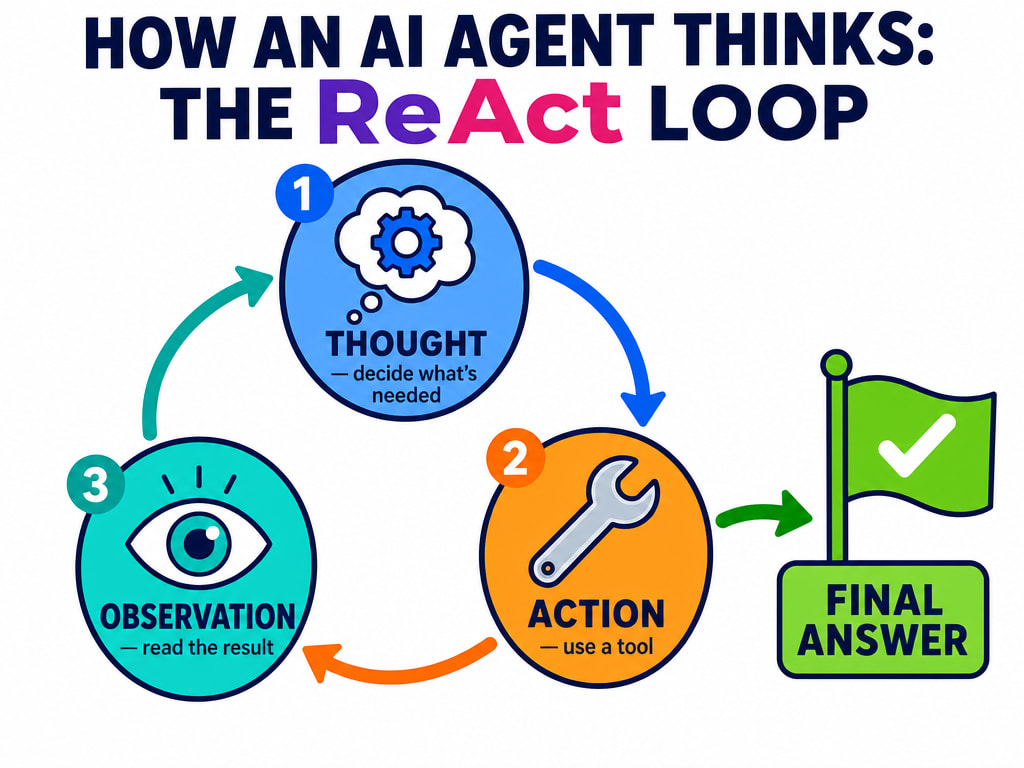
The important shift here is that the model isn't just producing an answer directly — it's deciding what information it needs, going and getting it through a tool, and only then answering. That's what separates "acting" from "generating text about acting."
| Tool | What it's for |
|---|---|
| Function calling / tools API | A cleaner, more direct way most major AI providers offer to let a model call predefined functions and use their results — usually the simplest starting point. |
| LangChain | A widely used framework for building more complex LLM applications, covered practically in the automation lesson — powerful, but with a steeper learning curve. |
| n8n / Make.com | No-code visual workflow tools that connect AI to other services without writing code at all — a genuinely accessible way to build real automation without a developer background. |
More Autonomy Means More Responsibility
An agent that can take real actions — sending emails, spending money, modifying data — needs real safeguards: clear limits on what it's allowed to do, human approval for anything consequential, and monitoring for when it goes wrong. More autonomy means more that can go wrong unsupervised, not just more that gets done.
You've now covered building genuinely capable AI systems. The next three lessons step back from building to using AI well in the wider world — where it shows up across industries, how to build a career around it, and how to use it responsibly.