

Turning a sentence into a picture feels like magic the first time you see it. This lesson explains what's actually happening, gives you a reliable formula for writing image prompts, and covers the copyright basics you need before using a generated image for real work.
This is called generative AI — AI that creates new content instead of just analysing existing content. Image models are trained on hundreds of millions of image-and-caption pairs (a photo of a sunset paired with a caption describing it), learning the statistical relationship between words and visual features. When you type a prompt, the model reconstructs a brand-new image matching those words — it does not search the internet or copy an existing photo.
The Painter Analogy
Imagine a painter who has studied a million paintings. Ask them to "paint a majestic tiger in a jungle at dawn, watercolour style," and they don't copy any single painting — they use everything they've learned to create something new. AI image generation works the same way. It also means these models learned from copyrighted images in the first place, which is exactly why the legal debate around this technology is still ongoing.
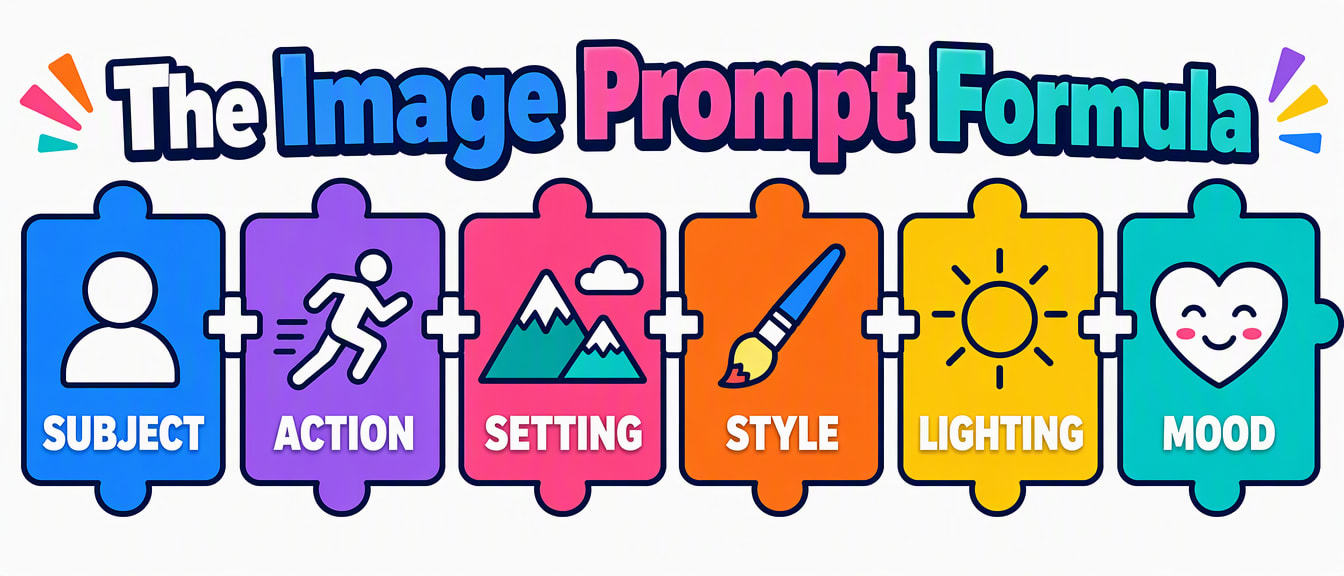
Image prompts respond well to a specific structure — stack these elements together and the result gets dramatically more specific:
[Subject] + [Action/Pose] + [Setting] + [Style] + [Lighting] + [Mood]Basic: "A white cat sitting on a window sill" — works, but generic.
Detailed: "A fluffy white Persian cat sitting on a wooden window sill in a cozy home, looking out at monsoon rain, soft warm lamplight from behind, detailed fur texture, photorealistic, bokeh background."
Commercial design: "A professional logo for a computer training academy. Modern, clean design. Deep blue and white colours. A stylised monitor icon. Sans-serif font. Flat design, vector style, white background."
Useful style keywords: photorealistic, watercolour, oil painting, cartoon, anime, minimalist, flat design, 3D render, sketch, digital art, cinematic.
Useful lighting keywords: golden hour, soft diffused light, dramatic shadows, studio lighting, backlit, natural daylight.
You now understand image generation for everyday, general use. The next lesson goes further — into the more technical, professional-grade techniques used for genuinely commercial creative work.