

A working mail server is not the same as reliable delivery. This lesson covers deliverability — why mail from a brand-new domain routinely lands in spam, and the records that fix it.
Every major mail provider (Gmail, Outlook, and the rest) runs incoming mail through spam filters that score it on sender reputation before it ever reaches an inbox. A domain with no history, no verification records, and no sending pattern to judge looks exactly like what spam typically looks like — new, unverified, unpredictable — regardless of how legitimate the actual content is.
| Record | What it proves |
|---|---|
| SPF | Which mail servers are allowed to send mail claiming to be from your domain — a receiving server checks the sending server against this list |
| DKIM | A cryptographic signature added to outgoing mail, proving it genuinely came from your domain and was not altered in transit |
| DMARC | A policy telling receiving servers what to do when SPF or DKIM fails — reject the mail, quarantine it as spam, or merely report the failure |
All three are TXT records, added to the same DNS panel covered in the connecting-a-domain lesson, and your email provider (from the previous lesson) supplies the exact values — this is not something to construct by hand.
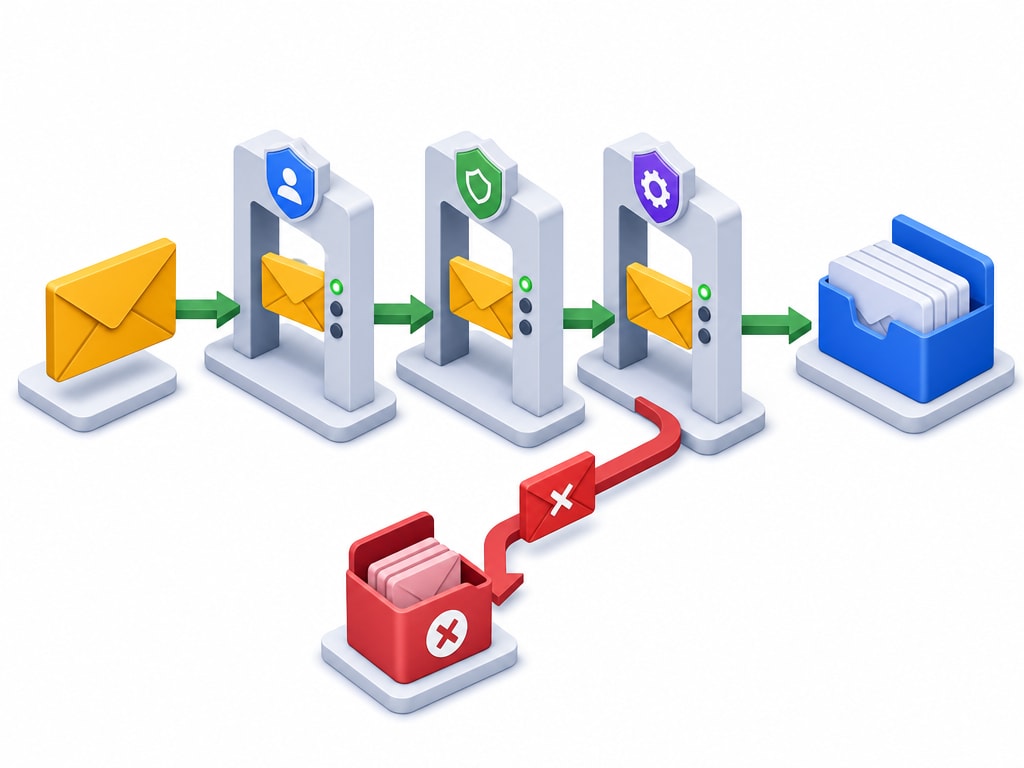
Correct records are necessary but not sufficient. Ongoing sending behavior matters just as much: a sudden volume spike, a high bounce rate from sending to invalid addresses, or a high complaint rate (recipients marking mail as spam) all damage a domain's reputation over time, independent of whether SPF and DKIM technically pass.
New domains need time, not just correct records
This is why a brand-new domain sending its first bulk email often lands in spam even with every record configured correctly — reputation is built over time by consistent, low-complaint sending, not established instantly by DNS records alone. It is a genuine reason to expect early friction, not a sign that something is misconfigured.
A contact-form notification or a password-reset email (transactional mail, sent one at a time in response to a user action) behaves very differently from a newsletter sent to a large list at once (bulk mail) — mail providers watch for the volume and pattern differences, and bulk sending is held to a noticeably stricter reputation standard. A dedicated transactional-email service is a common, worthwhile choice specifically for the contact-form and account-notification mail a website sends, separate from whatever handles a newsletter, if one exists at all.