

Every kind of hosting — shared, VPS, cloud, managed, static — is a variation on the same underlying thing: a computer, kept on and connected to the internet at all times, that you rent some share of. What differs between types is how much of that computer is yours, and how much control you have over it.
A physical server has a fixed amount of processing power, memory, storage, and network bandwidth. Every hosting type is really just a different answer to "how is that fixed amount divided up, and among how many customers?"
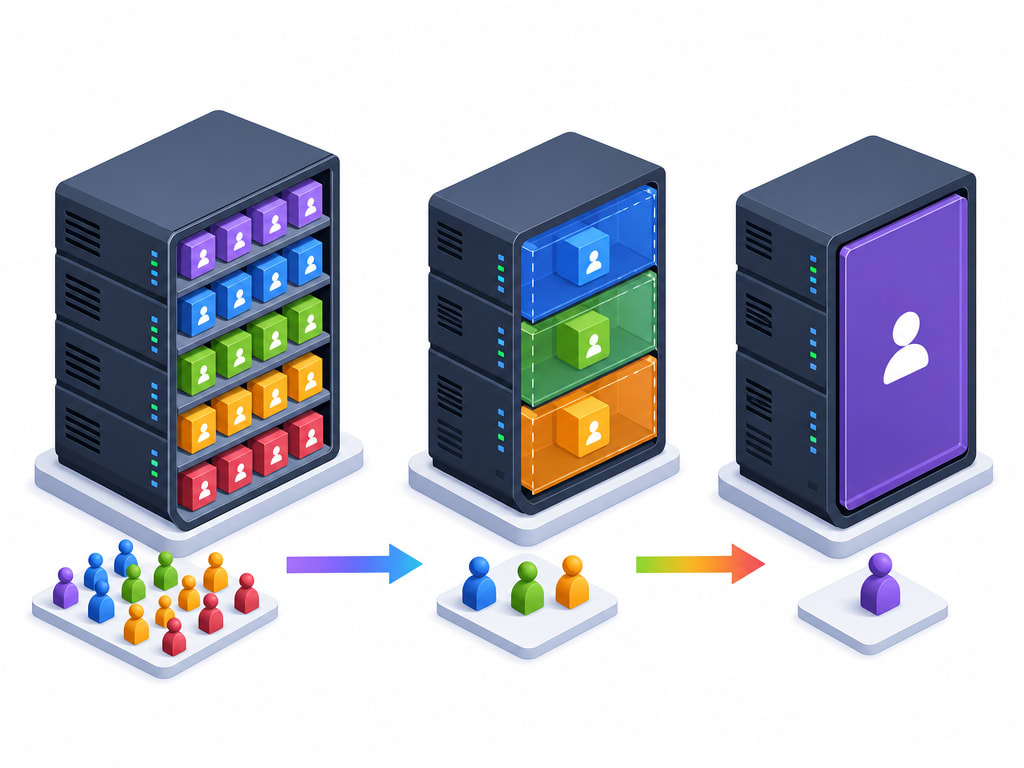
| Type | How resources are divided | Control you get |
|---|---|---|
| Shared hosting | Hundreds of sites split one physical server | Minimal — a control panel, not the server itself |
| VPS | A handful of virtual, isolated slices of one physical server | Full control of your own slice |
| Dedicated server | One customer, one entire physical server | Complete control of the whole machine |
| Cloud / managed platforms | Resources allocated dynamically, often across many machines | Varies widely — some feel like shared hosting, some like a VPS, automated behind the scenes |
| Static hosting | No server-side processing at all — just files, served from many locations at once | Minimal control needed, because there is no server to manage |
Each of these is covered in its own lesson next. The pattern worth noticing now: more control and more dedicated resources generally cost more and require more technical knowledge to manage — there is a real, direct trade-off, not a strictly better or worse option.
The more of the server is yours, the more of its maintenance is also yours: security updates, monitoring for problems, configuring the software that runs your site, and recovering it if something goes wrong. Shared hosting and most managed platforms handle all of that for you, invisibly, as part of what you pay for. A VPS or dedicated server leaves it to you — full control and full responsibility arrive together.
There is no universally "best" type. The right choice depends entirely on what you're running, how much traffic it expects, how comfortable you are managing a server yourself, and what you can afford — all covered concretely in the choosing-hosting-for-your-stack lesson later in this part.
The next several lessons take each type in turn — shared, VPS and dedicated, cloud and managed, and static — followed by a direct decision guide matched to the specific stacks taught on this site, and then what each tier actually costs.