

The part after the last dot — the top-level domain, or TLD — falls into a few broad categories. Knowing which is which helps when choosing a domain, and explains why some endings feel more "official" than others.
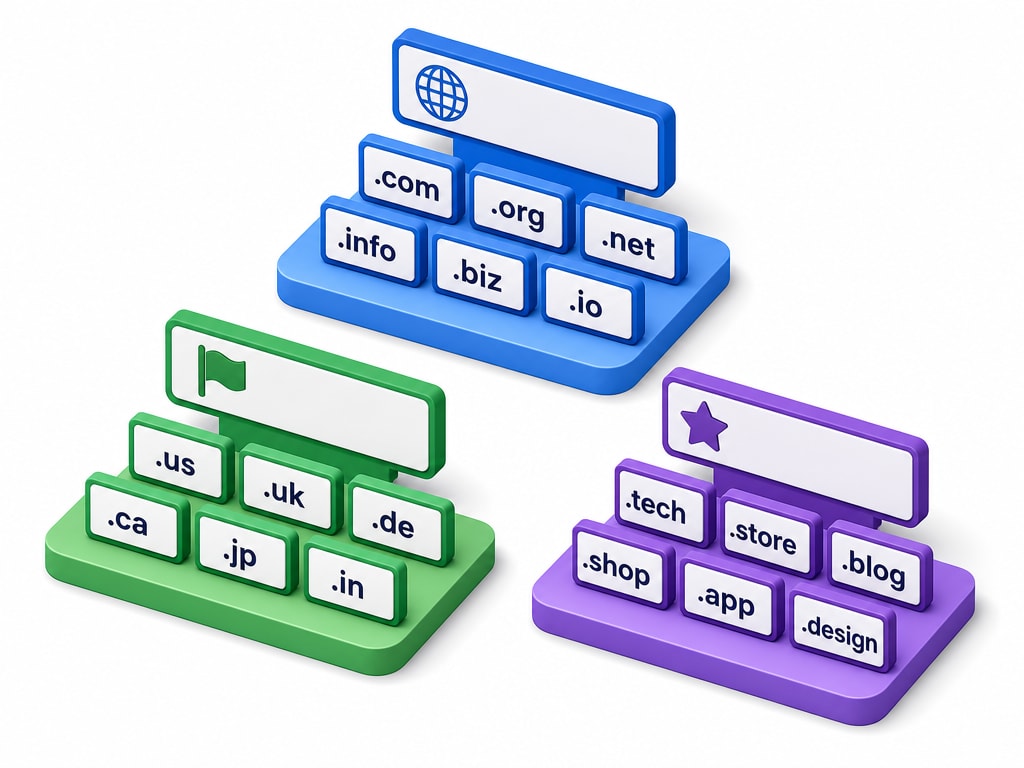
Open to registration by anyone, anywhere, with no geographic or organisational restriction. .com, .net, and .org are the oldest and most familiar; .com in particular is often treated as the default by users, even when it has no special technical meaning.
Assigned to a specific country or territory — .in for India, .uk for the United Kingdom, .us for the United States. Each is managed by an organisation designated for that country, and rules vary: some ccTLDs are open to anyone worldwide, others require local presence or documentation to register.
| TLD | Notes for India specifically |
|---|---|
| .in | India's general-purpose ccTLD, open registration, widely used by Indian businesses |
| .co.in | A subcategory under .in, historically used similarly to .com |
| .org.in | Intended for organisations, similar spirit to the generic .org |
| .net.in | Intended for network/infrastructure-related entities, though used loosely in practice |
A ccTLD like .in signals a connection to that country, which can build trust with a local audience specifically — genuinely useful for a business primarily serving Indian customers.
In recent years, hundreds of new endings have become available — .dev, .app, .io, .tech, .store, .blog, and many more. Some are lightly restricted (.dev and .app require HTTPS to be enabled, for instance) and some carry a specific connotation (.io is popular with tech startups, .store signals a shop) without any strict eligibility rules attached.
Search engines do not give .com a general ranking advantage over other legitimate TLDs on the strength of the ending alone — this site's SEO course covers what actually matters for ranking, and TLD choice is not one of the significant factors. The main real-world consideration is what a human visitor assumes or trusts when they see it, not an algorithm.
For most students building a portfolio or a first small business site, availability and price usually decide it more than any technical difference between TLDs. .com tends to be the most contested and thus the most likely to already be taken; a ccTLD like .in, or a newer TLD that fits the project, is often both available and perfectly legitimate.
A global body coordinates the overall domain name system and delegates each TLD to a specific registry organisation responsible for it. Individual domain names within a TLD are then sold to the public through accredited registrars — the companies covered in the next lesson, where you'll actually register one.