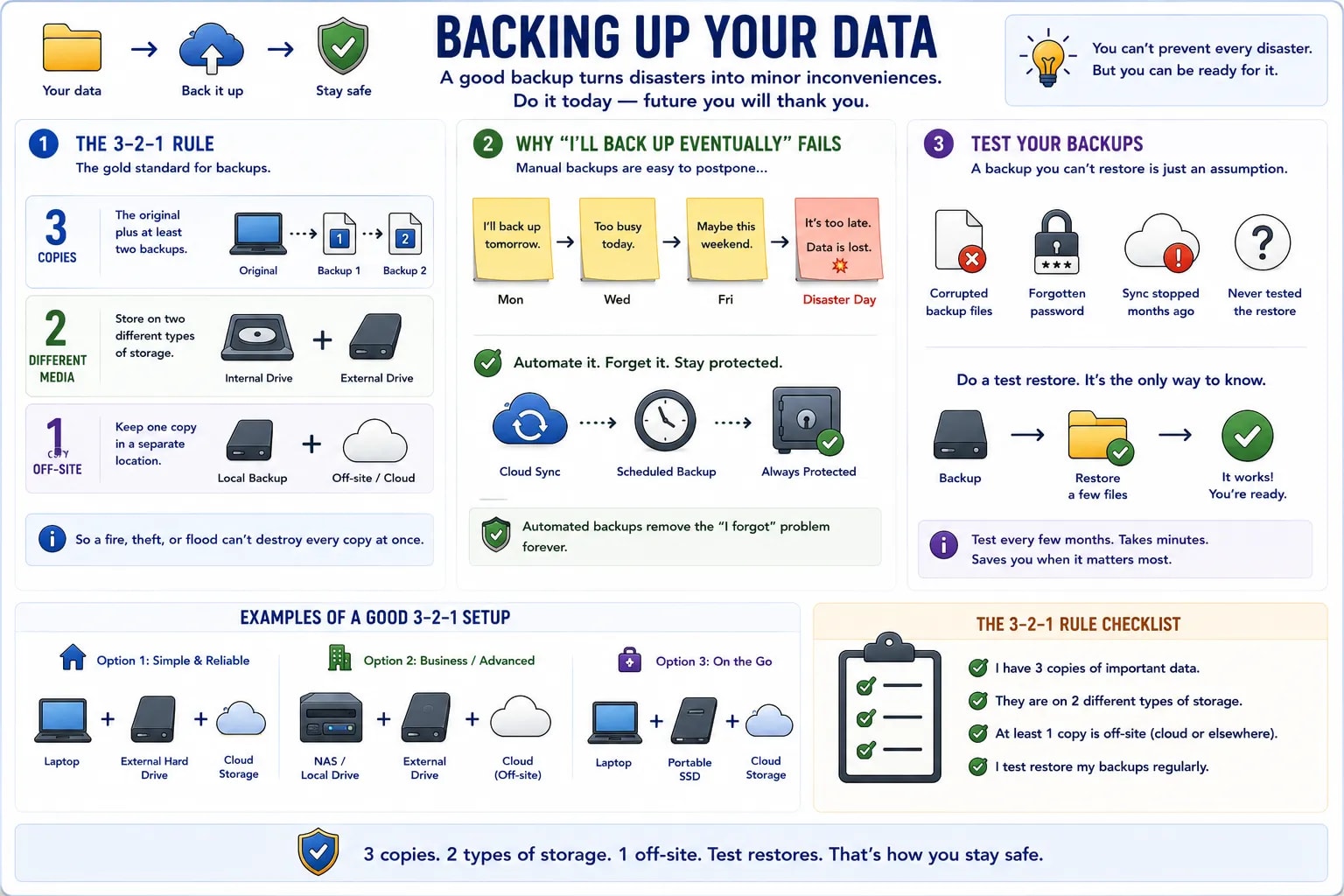
Ransomware, a failed hard drive, a stolen laptop, an accidental deletion — the causes are all different, but a good backup makes every single one of them a minor inconvenience instead of a genuine disaster. It's arguably the single highest-value habit in this entire course.
| Rule | What it means |
|---|---|
| 3 copies | The original plus at least two backups — one backup alone can also fail |
| 2 different media | Not all copies on the same type of drive — e.g. the laptop's drive plus an external drive, not two external drives |
| 1 copy off-site | At least one copy physically separate from the others — cloud storage, or a drive kept somewhere else entirely — so a fire, theft, or flood can't destroy every copy at once |
Manual backups get postponed indefinitely because there's never an urgent-feeling reason to do one today — until the day there very much is, and it's too late. An automated backup (cloud sync, a scheduled backup tool) that runs without being remembered removes this exact failure mode entirely.
A backup that has never actually been restored isn't a proven backup — it's an assumption. Corrupted backup files, a forgotten password on an encrypted backup, or a sync that silently stopped months ago are all discovered, almost always, at the worst possible moment: during an actual disaster. A periodic test restore of a few files catches this in advance instead.
The whole rule in one line
The 3-2-1 rule as a simple checklist: 3 copies of anything that matters, on 2 different kinds of storage, with 1 of those copies somewhere physically separate — and a restore actually tested at least once.